Case study
Production-Ready Secure Boot for a Connected Industrial Device
Hardware-rooted secure boot on an NXP i.MX RT-series MCU with Zephyr and MCUboot: controlled provisioning, signed updates, and authenticated service access.

Written by Filip Trajković
8 min read

- Client
- Confidential industrial device manufacturer
- Industry
- Industrial connected devices
- Technologies
- NXP i.MX RT series
- Zephyr RTOS
- MCUboot
- OTP fuses / ROM bootloader
- CI signing
- Signed debug certificates
- Serial ISP recovery
A manufacturer of connected industrial devices needed to close a critical gap: their field-deployed, battery-powered hardware had no protection against unauthorized or tampered firmware. Anyone with physical access could read, modify, or replace the code, and the device would run it without question.
MbedTroniX designed and integrated a complete hardware-backed secure boot chain of trust on the client’s NXP i.MX RT-series microcontroller – from the silicon’s ROM bootloader, through a signed MCUboot, to the signed application – together with the production key-management, provisioning, debug-authentication, and field-servicing infrastructure that makes secure boot safe to actually ship.
The result: firmware is accepted only when cryptographically signed by the client and verified through a hardware-rooted chain of trust at every boot – without disrupting the existing OTA update workflow.
At a glance
- 6validated security scenarios
- 4Root-of-Trust key slots
- 0changes to OTA release flow
- 1controlled field recovery path
Client and context
The client designs and manufactures connected industrial devices – battery-powered hardware that is deployed in the field and maintained over the air, built on the Zephyr RTOS with an MCUboot bootloader. As with most connected products, their firmware represents significant intellectual property and a growing security surface.
Two realities shaped the engagement. Manufacturing is handled by an external contract manufacturer, so any security step introduced into production had to be reliable enough for a factory the client does not directly control. At the same time, a small engineering team ships firmware updates regularly, so the security work could not slow down development or complicate the way they build and release code.
Why now: CRA pressure
For connected devices sold into the EU, the Cyber Resilience Act (CRA) reporting obligations have applied since 11 September 2026, and the main obligations apply from 11 December 2027. Secure boot alone does not make a product CRA-compliant, but it is one of the core firmware-trust controls that helps reduce regulatory and product-security risk. This case study shows a firmware-trust foundation for connected products preparing for CRA-aligned secure-by-design practices.
Challenge
Out of the box, the device offered no protection at the boot level. This exposed concrete risks around execution of unauthorized or counterfeit firmware, tampering with malicious code, and the absence of any trusted way to gate debug-port access.
The risks
- Unauthorized firmware. A counterfeit, modified, or malicious image could be accepted by the device.
- Tampering. A physical attacker could alter firmware and have the unit execute it without a trusted verification step.
- Uncontrolled debug access. There was no trusted mechanism to gate access to the debug port.
The non-negotiable constraints
- Irreversible configuration. The MCU security configuration lives in one-time-programmable fuses. Every mistake is permanent.
- Protected signing keys. Key material had to remain protected across CI and factory operations handled by a third party.
- No loss of serviceability. MCUboot OTA updates, authorized debugging, and field recovery all had to continue to work.
The design principle
Secure boot that leaks its own keys, or that turns every field fault into a bricked unit, is worse than no secure boot at all. The challenge was to lock the device down and keep it maintainable.
Solution
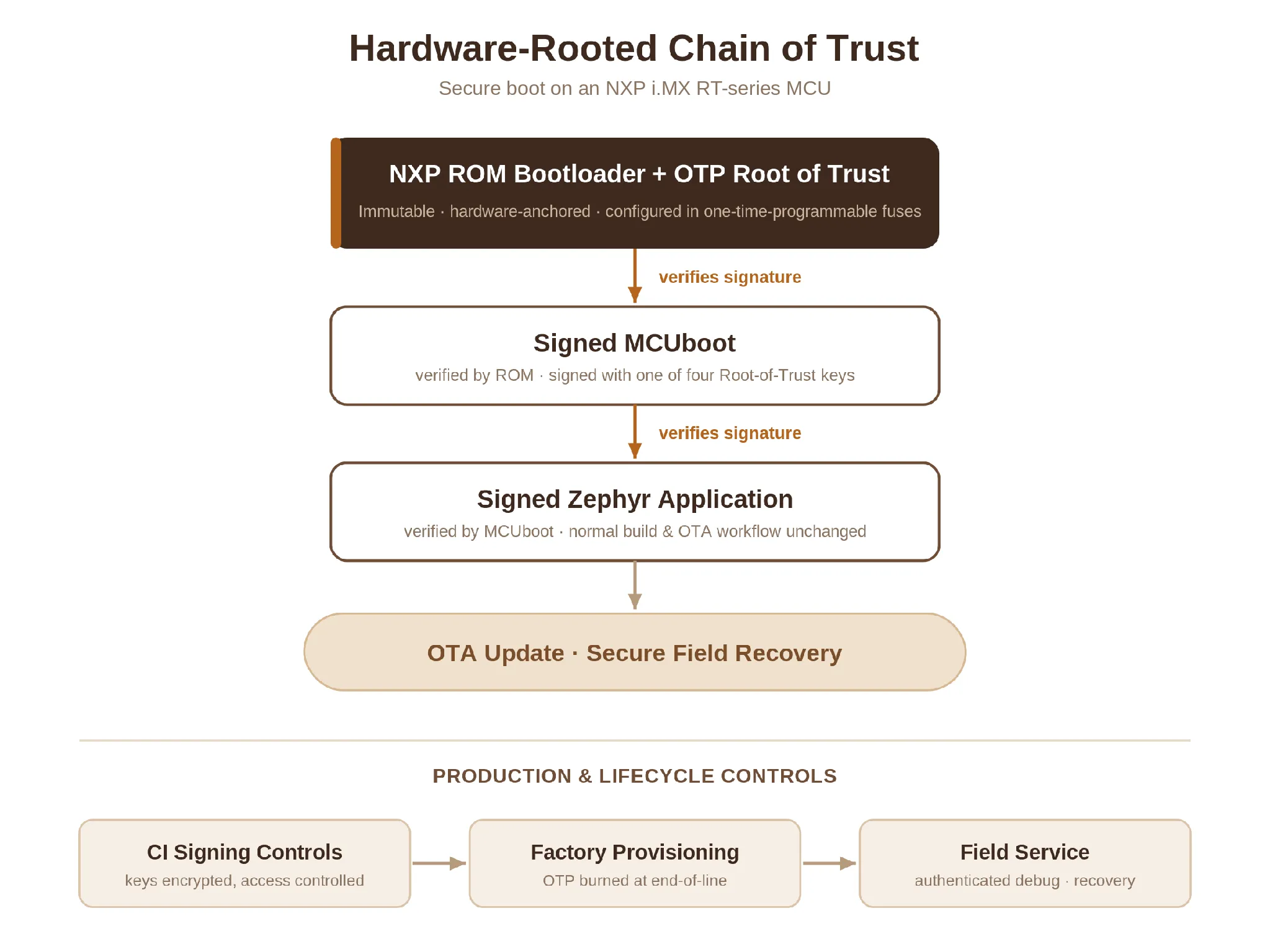
MbedTroniX implemented a full chain of trust anchored in hardware. The MCU’s immutable ROM bootloader – configured through OTP fuses – acts as the root of trust and verifies the signature of MCUboot before executing it. MCUboot, signed with one of four Root-of-Trust keys, in turn verifies the signed application.
Because the application layer is untouched, secure boot is effectively transparent to the client’s developers: they build and release firmware exactly as before.
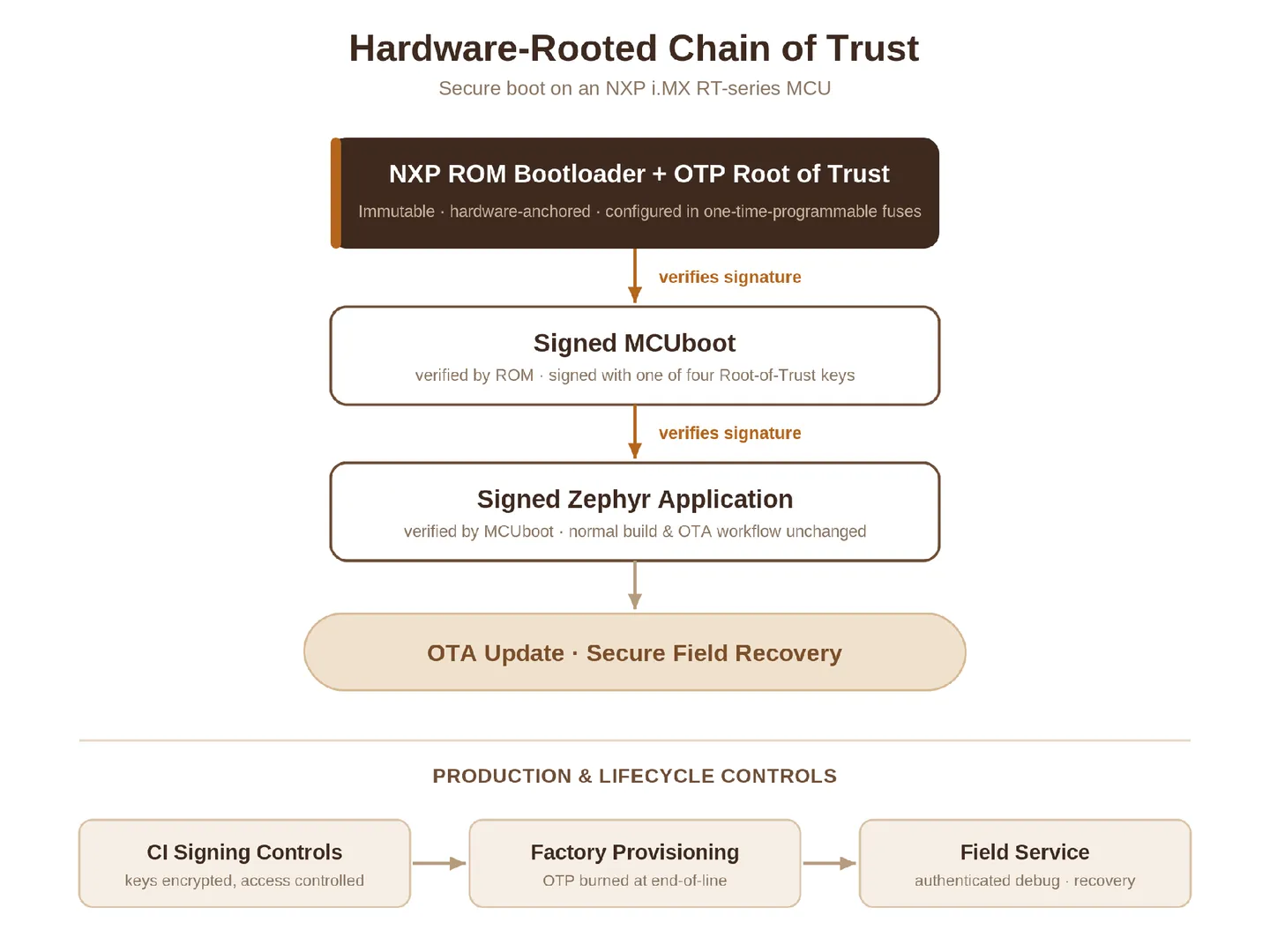
Why this matters. The design separates trusted boot verification from normal application development, while preserving a controlled path for updates, authorized diagnostics, key compromise response, and service recovery.
Key capabilities
- Hardware root of trust: OTP-configured ROM boot.
- Signed firmware chain: ROM → MCUboot → application.
- Controlled signing: CI-held signing material.
- Authenticated debug: certificate-gated service access.
- Key revocation: managed compromise response.
- Field recovery: serial recovery on secured units.
Production-grade controls
The boot chain is only the center of the solution. The following controls made it safe to deploy at scale, through an external manufacturing process and across the full service life of the device.
- Key protection. Private signing material was encrypted at rest and made available only inside the controlled CI signing environment, rather than distributed across developer workstations or factory systems. The signed bootloader is frozen and version-controlled for reproducible releases.
- Safe, irreversible provisioning. OTP fuse configuration is generated automatically and burned only during factory end-of-line provisioning. Production firmware has no ability to access OTP registers. Every configuration was first validated in the MCU’s reversible shadow-register mode before anything permanent was committed.
- Key revocation. A compromised Root-of-Trust key can be retired in the field and firmware can be re-signed with a fresh, still-trusted key – no hardware recall required.
- Authenticated debug. The debug port is locked on secured devices but can be reopened by authorized staff using signed debug certificates, preserving diagnostic access without weakening the device for everyone else.
- Field serviceability. A recovery route can re-flash firmware – including bootloader and application together – over the serial ISP interface on a fully secured device, so units remain serviceable after deployment.
Operational result. The production process can apply the irreversible security configuration with confidence, while developers retain a familiar release workflow and field teams retain controlled service access.
Results and impact
The delivered system was validated end to end against the scenarios that matter most. The evidence below confirms that the device rejects untrusted code, protects the boot configuration, and remains updatable and serviceable.
| Validation scenario | Observed behaviour | What it proves |
|---|---|---|
| Signed image | Correctly signed firmware boots normally. | Normal trusted release path. |
| Unsigned image | The device rejects it and remains in its defined secure failure state. | Untrusted code is not executed. |
| Single-byte tamper | Signature validation fails; the secured device refuses to execute the changed image. | Fail-closed integrity protection is active. |
| OTP rollback attempt | Secure boot cannot be disabled after provisioning. | Irreversible hardware configuration is enforced. |
| Root-of-Trust revocation | The revoked bootloader is rejected at the next boot; recovery can restore images signed by a still-trusted key. | Compromise response is managed, not a fleet-wide outage. |
| Debug and recovery | Debug connects only with a valid certificate; serial recovery remains available for controlled restoration. | Security does not remove serviceability. |
Delivered impact
The client’s product now enforces a hardware-rooted chain of trust that runs only authorized firmware. It prevents unauthorized firmware from executing, reduces exposure to tampering and counterfeit firmware, restricts debug access to authorized personnel, and remains fully updatable and serviceable – with no change to how their engineers work.
Business outcome
- Production-ready firmware trust model
- OTA releases, diagnostics, manufacturing flow, and field recovery preserved
- Clear security story for customers and auditors
Engineering outcome
- Repeatable provisioning before irreversible OTP configuration
- Existing developer workflow kept intact
- Six failure-mode scenarios validated end to end
Security and compliance foundation
A hardware-rooted firmware-trust foundation that supports CRA-aligned secure-by-design practices, including signed firmware, controlled provisioning, authenticated debug access, and secure field recovery.
Lessons learned
Secure boot is less about flipping a single secure switch and more about building a trustworthy system around it. Signing an image is the easy part; protecting the keys, making an irreversible factory step safe to run, and preserving debugging, updates, and recovery is where the real work lies.
- Test permanent settings reversibly first. Shadow-register and dry-run modes let teams validate the exact configuration before the one-way fuse burn.
- Treat key management as the real project. The cryptography is standard. Operational security around CI signing and factory provisioning is where security is won or lost.
- Design for the day something goes wrong. Key revocation, authenticated debug, and a field-recovery path make a locked-down device supportable in production rather than fragile.
How we can work together
Secure Boot / CRA Readiness Assessment
A practical entry point for teams that need to harden a connected product before CRA deadlines or before a security-sensitive release.
A low-risk first step: 2 weeks, fixed-scope, fixed-price. For connected industrial devices using Zephyr, MCUboot, NXP MCUs, OTA updates, or external contract manufacturing, MbedTroniX can assess the current boot and update chain. The goal is to identify the current firmware-trust gap, map the product against CRA-aligned secure-by-design expectations, and define the shortest credible path to signed firmware, controlled provisioning, authenticated debug, and secure recovery.
- Boot and update review. Review MCU boot flow, bootloader, OTA path, debug state, flash layout, and device lifecycle assumptions.
- CRA-aligned risk mapping. Identify where secure boot supports CRA expectations and where other controls are still missing, such as SBOM, vulnerability handling, interface security, and support policy.
- Provisioning and key strategy. Define signing-key custody, CI signing flow, factory provisioning boundaries, irreversible OTP/fuse handling, and revocation strategy.
- Implementation roadmap. Deliver a prioritized plan with engineering tasks, test scenarios, ownership, and recommended next engagement scope.
What the client typically provides
- Current bootloader and application build flow
- MCU/SoC security reference manual and current flash/fuse configuration
- OTA update mechanism and release process
- Manufacturing/provisioning constraints and available factory tools
Decision rule. If the product already has a credible firmware-trust and CRA-readiness path, the assessment ends with confirmation and specific remaining risks. If not, it turns ambiguity into a concrete implementation roadmap.